
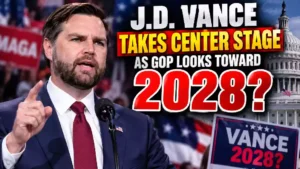
JD Vance Fires Up GOP
JD Vance Fires Up GOP Base as 2028 Presidential Speculation Intensifies JD Vance Takes Center Stage as GOP Looks Toward

Greenland has reemerged as a global flashpoint because of where it sits, what it holds, and who might control it in the future.
Geographically, Greenland is part of North America, located between the United States, Europe, and Russia. That position makes it strategically vital for missile defense, Arctic surveillance, and control of emerging shipping routes as polar ice continues to recede.
Militarily, the U.S. already operates Pituffik Space Base (formerly Thule Air Base), a critical early-warning and space-tracking installation. As Russia modernizes its Arctic forces and China labels itself a “near-Arctic power,” U.S. defense planners increasingly view Greenland as a frontline asset rather than a remote outpost.
Economically, Greenland is rich in rare-earth minerals, uranium, and critical resources needed for advanced electronics, renewable energy, and artificial intelligence—materials that are currently dominated by China in global supply chains.
Politically, Greenland is an autonomous territory of Denmark, which is a NATO member but has limited ability to defend or develop the island independently. That gap has fueled debate over whether existing arrangements adequately protect Western security interests.
Finally, former and current U.S. leaders—including Donald Trump—have argued that if the United States would be expected to defend Greenland in a crisis, it must have greater authority over its security. Supporters frame this as conflict prevention; critics see it as overreach.
In short, Greenland is in the news because the Arctic is no longer remote, and control of strategic geography is once again shaping global power politics.
#Davos2026 #GreenlandGeopolitics #AmericaFirst #GlobalPowerShift #ArcticSecurity
As the World Economic Forum (WEF) convenes once again in Davos, Switzerland, the annual gathering of global elites arrives under a cloud of skepticism, satire, and geopolitical tension. Once viewed as the nerve center of global decision-making, Davos increasingly feels like a stage where old assumptions collide with a rapidly changing world order.
The escorts have landed, luxury hotels are booked, climate lectures are underway, and world leaders have descended on the Swiss Alps. But beneath the pageantry lies a deeper question: does Davos still matter in 2026?
For years, Davos positioned itself as the headquarters of globalism—promoting open borders, climate mandates, centralized governance, and elite consensus. Critics argue the forum has lost touch with everyday citizens, pushing policies such as electric-vehicle mandates, dietary restrictions, and repeated booster campaigns while global trust erodes.
Even prominent financial executives have begun acknowledging the problem. If the World Economic Forum wants relevance moving forward, it must regain trust—not dictate lifestyle choices from a mountaintop.
Authority today, critics say, no longer rests on speeches and symbolism. It rests on power, realism, and national interest.
President Donald Trump arrived in Europe with little interest in tradition or diplomatic theater. His approach—often described as blunt or transactional—has once again rattled European leaders accustomed to consensus politics.
Trump’s message has been consistent: America will secure its interests—militarily, economically, and strategically—without apology.
That message has been felt most strongly in a renewed debate over Greenland.
Greenland, the world’s largest island, sits squarely in the Western Hemisphere and holds immense strategic value. It lies between North America, Europe, and Russia, making it critical for missile defense, Arctic shipping lanes, and access to rare-earth minerals essential for advanced technology and artificial intelligence.
The United States has pursued Greenland before. After purchasing Alaska, President Andrew Johnson explored the idea. President Harry Truman later offered Denmark $100 million in gold—an offer that, in hindsight, would be worth billions today.
During World War II, when Denmark fell to Nazi Germany, the United States defended Greenland to prevent enemy occupation. After the war, Washington returned control—an act some now view as generosity rather than obligation.
At the heart of the current dispute is defense responsibility. NATO members are required to defend their own territory. Critics argue Denmark has failed to meet that obligation in Greenland, investing minimally in infrastructure or military readiness.
An underdeveloped island rich in strategic resources represents, in this view, a gaping hole in NATO’s defense architecture. As global competition intensifies—particularly with China and Russia—the concern is not conquest by the United States, but vulnerability to adversarial powers.
Trump’s position is blunt: if the U.S. will inevitably be called upon to defend Greenland, then America must have decisive control over its security.
European leaders have reacted sharply. Canadian officials reaffirmed support for Danish sovereignty. French President Emmanuel Macron publicly questioned U.S. intentions, while also courting Chinese investment to stabilize Europe’s economy.
That contradiction has not gone unnoticed. As China expands its influence through foreign direct investment and Russia presses forward in Ukraine, some critics argue Europe is relying on American protection while resisting American leadership.
Trump, in response, has signaled economic pressure—floating the idea of steep tariffs on European luxury exports such as French wine and champagne.
The COVID-19 pandemic accelerated trends already underway. Global supply chains fractured. Shipping lanes became strategic assets. Nations rediscovered the risks of dependence.
In this new reality, “globalism” has given way to national resilience. Control of minerals, energy, transportation routes, and defense systems now outweighs abstract commitments to multinational consensus.
Greenland is not about invasion. It is about preventing future conflict by ensuring stability in the Arctic before rivals exploit weakness.
As Politico recently noted, Trump is on track to reshape America’s relationship with the world more profoundly than any president in decades. Supporters call it realism. Critics call it disruption. Either way, the shift is undeniable.
The message from Washington is clear: America will remain allied with Europe—but not subordinate to it.
For those watching nervously, the advice from both sides of the Atlantic may be the same: don’t panic, don’t escalate, and understand the strategy before reacting.
Or, as one Nordic diplomat suggested—take a breath, step into the sauna, and cool off.



JD Vance Fires Up GOP Base as 2028 Presidential Speculation Intensifies JD Vance Takes Center Stage as GOP Looks Toward

Oklahoma State Fans Roll Out the Welcome Mat for Oregon Supporters Ahead of Home Opener Oklahoma State Fans Welcome Oregon

FBI Deputy Director Chris Rea Marks 25 Years Since 9/11 With Call to Serve America 25 Years After 9/11 FBI
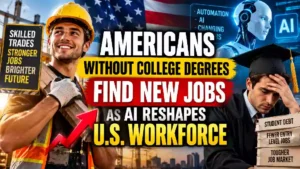
Americans Without College Degrees Find New Jobs as AI Reshapes US Workforce Americans Without College Degrees Are Finding New Opportunities

Stephen Miller Takes Aim at Democrats’ Progressive Wing Ahead of 2026 Election Stephen Miller Warns Democrats’ Progressive Wing Could Become

The First 17 Minutes of 9/11: How America Went From Confusion to Crisis 9/11’s First 17 Minutes: How America Went

Republicans Warn of Socialist Influence as Texas Democrats Gain Ground Ahead of 2026 Midterms Republicans Sound Alarm Over ‘Far-Left’ Democrats

US Pressure on Iran Enters New Phase as Strait of Hormuz Blockade Intensifies US Tightens Grip on Iran as Strait

AI Super Weapon Warning: Former Anthropic Researcher Raises Alarm Over AI Safety Former Anthropic Researcher Sounds Alarm: Is AI Becoming

RFK Jr Drops a Political Bombshell: “The Democratic Party Left Me” RFK Jr Explains Why He Left the Democrats and

Newt Gingrich Warns Democratic Socialist Shift Could Transform America Ahead of 2026 Elections Gingrich Warns Voters: Democrats’ Socialist Shift Could

Oklahoma Burn Ban Violations: Fines Jail Time and What Residents Need to Know Breaking a Burn Ban in Oklahoma Could

Danbury Opens Police Jobs to DACA Recipients and Legal Residents Sparking Fierce Public Safety Debate Danbury Police Hiring Rule Sparks

Derek Van Orden Warns “Socialism Doesn’t Fly” as Wisconsin Midterm Race Heats Up “SOCIALISM DOESN’T FLY”: Derek Van Orden Draws

One Year After Charlie Kirk’s Assassination: Supporters Honor His Legacy One Year Later Charlie Kirk Supporters Return to the Campus